During the third millennium BC, southern Mesopotamia was home to the world's earliest urban societies, among them Ur, a Sumerian city-state. Leonard Woolley described Sumer as one of the earliest civilisations in the urban sense, and the archaeological remains from Ur reveal a society in which status could be expressed through architecture, burial practice and access to materials unavailable locally (Woolley, 1965, p. 1), and where prosperity relied on specialist craft production and exchange. The ruins of Ur now stand in the desert of southern Iraq, though the city originally developed beside the Euphrates River. Excavations began in 1922 under Woolley, on behalf of the British Museum and the University Museum of Pennsylvania, and four years later, uncovered the cemetery that became one of the most significant archaeological discoveries from ancient Mesopotamia (Aruz, 2003, pp. 93–94).
The cemetery was in use for several centuries during the later third millennium BC. The more recent graves were individual burials that frequently disturbed earlier burials, and men and women were buried with possessions whose quantity and quality differed considerably, evidence of varied wealth and status (Aruz, 2003, pp. 93–94). The grandest of these graves are commonly known as the Royal Tombs, reflecting their scale, the richness of their contents, and the ceremonial presentation of the bodies.
The jewellery recovered from the Royal Tombs helps to examine Sumerian society. Gold, lapis lazuli, and carnelian were all regularly used, and each had to be obtained through long-distance trade before reaching Mesopotamia, where skilled craftspeople transformed them into ornaments that were worn in life and placed with the dead to express wealth, identity, and status. This project aims to review these materials, specifically four pieces of jewellery from the Ashmolean Museum to explore how imported materials, specialist manufacture and funerary practice came together at Ur.
Unlike carved reliefs or narrative scenes, jewellery communicated through appearance: materials, colour, form and placement conveyed meaning without imagery or inscriptions. Jewellery included gold, which reflected access to a scarce imported metal, lapis lazuli which was unavailable locally, and carnelian, a harder and more durable material, together reinforcing distinctions of identity and status (Zettler and Horne, 1998, pp. 87–88). Often, these precious materials entered Mesopotamia raw before being worked by local specialists (Zettler and Horne, 1998, pp. 88–89), so the finished ornaments owed their value to technical skill as much as to the rarity of their materials.
No gold deposits are known to be from Mesopotamia, so it had to be imported, most likely as nuggets (Moorey, 1994, pp. 217–221). Zettler and Horne add that gold also reached Ur as ingots (Zettler and Horne, 1998, p. 89). As gold is soft and workable, metalworkers hammered it into thin sheets, folded it around cores and joined pieces by soldering, producing designs from little metal (Zettler and Horne, 1998, pp. 88–89).
Lapis lazuli, one of the most valued ornamental stones in ancient Mesopotamia, is composed principally of hauynite, of which lazurite is a variety, together with pyrite and calcite, producing its characteristic deep blue. No ancient written source identifies its geological origin, and since it was traded widely throughout antiquity, its ultimate source remains unknown; paired with gold, its intense blue created a striking visual contrast (Moorey, 1994, pp. 85-86).
Carnelian is a reddish, translucent variety of chalcedony, a microcrystalline form of quartz, measuring approximately 7 on the Mohs scale (Moorey, 1994, p. 96), hard enough to resist wear, while its colour contrasted effectively with gold and lapis lazuli alike. It generally reached Mesopotamia as raw material, although Zettler and Horne have identified certain alkali-etched beads as finished imports associated with Harappan production (Zettler and Horne, 1998, pp. 88–89).
Gold Earrings
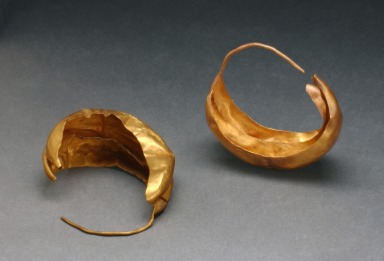
The gold earrings are crescent-shaped, a form Maxwell-Hyslop describes as lunate (Maxwell-Hyslop, 1971, p. 4); though simple in outline, their manufacture required considerable skill, and their size would have made them a prominent feature of the wearer's appearance. Maxwell-Hyslop identifies soldering as part of their construction and notes that the pin is thin enough to suggest it may have passed through a pierced ear (Maxwell-Hyslop, 1971, p. 5). The method of wearing them remains uncertain: some comparable examples contained bitumen, suggesting they instead fitted over the ear rather than hanging from a piercing. Zettler and Horne favour the over-the-ear reading for larger examples, though neither can be confirmed (Zettler and Horne, 1998, p. 107).
Necklace of Triangular Gold and Lapis-Lazuli Segments
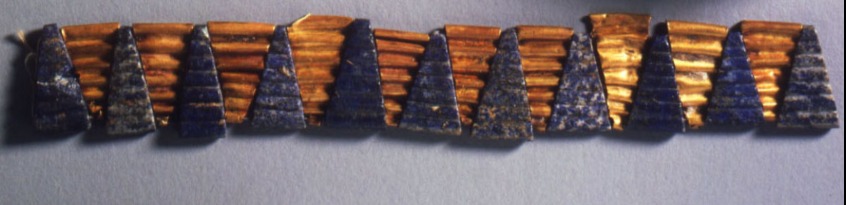
This necklace consists of alternating triangular elements of gold and lapis lazuli forming a close-fitting collar, a style Maxwell-Hyslop identifies as characteristic of the Early Dynastic period (Maxwell-Hyslop, 1971, p. 6). The lapis lazuli elements were each cut from a single piece of stone and drilled horizontally for threading, while the gold elements were formed from thin sheets wrapped around rods to produce hollow, strung sections (Maxwell-Hyslop, 1971, p. 6), similar in size to the lapis segments, but made using different techniques and skills.
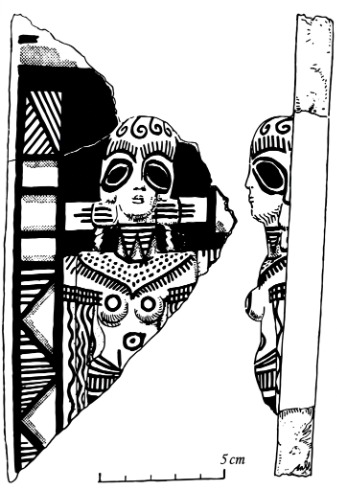
Zettler and Horne likewise describe this style of necklace as built from individually cut lapis lazuli elements combined with hollow sheet-gold components and note that necklaces of this type appear on terracotta female figurines across Mesopotamia (see Figure 6), evidence that they formed part of elite dress as well as funerary display (Zettler and Horne, 1998, p. 109). Similar collars have been recovered from more than one burial in the Royal Cemetery, indicating a recognised style rather than a unique object (Aruz, 2003, pp. 123, 127).
Gold and Lapis-Lazuli Necklace
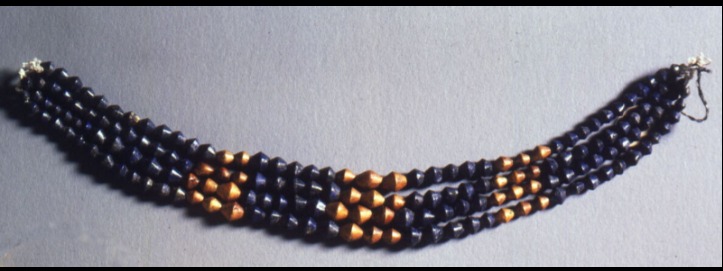
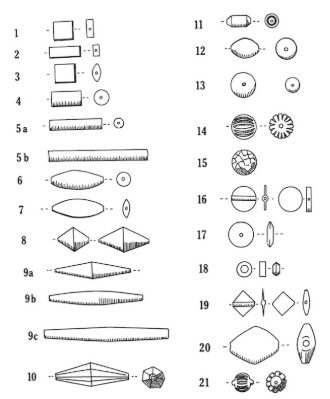
This necklace is composed of individual beads strung along a single strand, relying on repetition for a restrained but deliberate effect. Using Woolley's typology, the beads can be classified as Type 8 (see Figure 5), identified against the illustrations reproduced by Maxwell-Hyslop (Maxwell-Hyslop, 1971, p. 8). The alternating gold and lapis lazuli create a regular rhythm along the strand, an effect depending on colour as much as form. Zettler and Horne describe jewellery from the Royal Cemetery generally as symbolic rather than narrative, communicating through materials and appearance rather than imagery or inscriptions (Zettler and Horne, 1998, pp. 87–89); here, gold and lapis lazuli together made wealth and specialist craftsmanship immediately visible.
Carnelian Beads
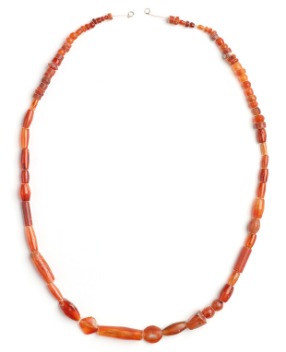
This strand is composed entirely of carnelian and incorporates several bead forms — Types 9b, 5a, 6, 8, 12, 18 and 4 in Woolley's typology (Figure 5), identified against Maxwell-Hyslop's illustrations (Maxwell-Hyslop 1971, p. 8). The arrangement appears intentional, with larger beads toward the front and progressively smaller ones toward the closure, possibly drawing attention to the front while improving flexibility at the back of the neck, and suggesting visual balance was considered during construction. The range of forms shows the strand was built from established bead types, not a single repeated design.
As with the other objects examined, this necklace reflects exchange beyond southern Mesopotamia. Carnelian was generally imported before being worked locally. Zettler and Horne identified certain etched carnelian beads as finished imports associated with Harappan production, but there is no evidence the Ashmolean necklace belongs to this group, as it lacks the alkali-etched decoration (Zettler and Horne, 1998, pp. 88–89).
The four objects examined illustrate the close relationship between exchange, craftsmanship and funerary practice at Ur. Precious metals and stones reached southern Mesopotamia through long-distance exchange before being transformed by local craftspeople into finished ornaments, their value resting on technical knowledge as much as on the rarity of the raw materials. Within the Royal Tombs, these objects formed part of the presentation of the dead, expressing wealth, identity and social distinction through material, colour and form. The recurrence of particular styles across burials suggests these ornaments belonged to recognised traditions of elite dress, while Woolley's bead typology reveals deliberate choices easily overlooked when objects are considered only as displays. Viewed together, these pieces show that jewellery from Ur was more than decoration: it brought together imported materials, skilled manufacture and funerary ritual in objects that communicated identity long after their wearer's life had ended.
Explore the display.
A low-resolution photogrammetry record made during a July 2026 visit to the Ashmolean Museum. The model includes the first three objects discussed in this essay; the carnelian beads are not represented.
Full-resolution record · 32 MB download after opening
Supplementary visitor-made documentation, not a metrically verified model or a high-resolution record. Rotation is limited to the visible display face; the back and underside are incomplete. Museum objects: Ashmolean Museum, University of Oxford.
Bibliography
Aruz, J. (2003) Art of the First Cities: The Third Millennium B.C. from the Mediterranean to the Indus. New York: The Metropolitan Museum of Art; New Haven and London: Yale University Press.
Ashmolean Museum (n.d.) Gold earrings, AN1930.219. [Online] Available at: https://collections.ashmolean.org/object/461502 (Accessed: 16 July 2026).
Ashmolean Museum (n.d.) Necklace of triangular gold and lapis lazuli segments, AN1930.221. [Online] Available at: https://collections.ashmolean.org/object/462057 (Accessed: 16 July 2026).
Ashmolean Museum (n.d.) Gold and lapis lazuli necklace, AN1930.222. [Online] Available at: https://collections.ashmolean.org/object/462058 (Accessed: 16 July 2026).
Ashmolean Museum (n.d.) Carnelian beads, AN1935.790. [Online] Available at: https://collections.ashmolean.org/object/469525 (Accessed: 16 July 2026).
Maxwell-Hyslop, K.R. (1971) Western Asiatic Jewellery c. 3000–612 B.C. London: Methuen & Co. Ltd.
Moorey, P.R.S. (1994) Ancient Mesopotamian Materials and Industries: The Archaeological Evidence. Oxford: Clarendon Press.
Woolley, C.L. (1965) The Sumerians. Oxford: Clarendon Press.
Zettler, R.L. and Horne, L. (eds.) (1998) Treasures from the Royal Tombs of Ur. Philadelphia: University of Pennsylvania Museum of Archaeology and Anthropology.
Illustrations
Figure 1. Gold earrings (AN1930.219), c. 2600–2400 BC. Source: Ashmolean Museum, University of Oxford. [Online] Available at: https://collections.ashmolean.org/object/461502 (Accessed: 16 July 2026).
Figure 2. Necklace of triangular gold and lapis lazuli segments (AN1930.221), c. 2500–2200 BC. Source: Ashmolean Museum, University of Oxford. [Online] Available at: https://collections.ashmolean.org/object/462057 (Accessed: 16 July 2026).
Figure 3. Gold and lapis lazuli necklace (AN1930.222), c. 2600–2400 BC. Source: Ashmolean Museum, University of Oxford. [Online] Available at: https://collections.ashmolean.org/object/462058 (Accessed: 16 July 2026).
Figure 4. Carnelian bead necklace (AN1935.790), c. 2900–2750 BC. Source: Ashmolean Museum, University of Oxford. [Online] Available at: https://collections.ashmolean.org/object/469525 (Accessed: 16 July 2026).
Figure 5. Woolley’s bead typology. Source: Adapted by the author from Maxwell-Hyslop, K.R. (1971) Western Asiatic Jewellery c. 3000–612 B.C. London: Methuen & Co. Ltd., p. 8.
Figure 6. Terracotta female figurine from Assur. Source: Reproduced from Zettler, R.L. and Horne, L. (eds.) (1998), p. 109, after Andrae (1922, pl. 28c).
Explore more in Writing or Research. The original essay remains unchanged while editorial suggestions are reviewed.